Skeleton Graph Metadata
GCNs need an adjacency structure; Transformers need joint groupings; mirroring needs left/right pairs. pybvh-ml extracts this topology data from a Bvh object — the data models consume, never the model components themselves.
The extractors
import pybvh_ml

edges = pybvh_ml.get_edge_list(bvh)            # [(child, parent), ...]
lr_pairs = pybvh_ml.get_lr_pairs(bvh)          # [(left, right), ...] index pairs
partitions = pybvh_ml.get_body_partitions(bvh) # {"torso": [...], "left_arm": [...], ...}

node_edges = pybvh_ml.get_edge_list(bvh, include_end_sites=True)
node_pairs = pybvh_ml.get_node_lr_pairs(bvh)   # node-space L/R, end sites included
get_edge_list— parent/child joint index pairs, the input to any GCN adjacency matrix.include_end_sites=Trueswitches to node space.get_lr_pairs— left/right joint index pairs, detected from joint names via pybvh's L/R heuristics (LeftArm/RightArm,LArm/RArm,arm_l/arm_r, …). This is whatmirrorconsumes forjoint_rotandjoint_pos.get_node_lr_pairs— the same pairing in node space, covering joints and their end sites. Whatmirrorneeds for anode_posstream, so the fingertips swap sides too.get_body_partitions— named body-part groups (torso, arms, legs, head) as joint index lists, for part-based pooling or attention masks.
Two index spaces, and they are not interchangeable
Joint space (bvh.joint_angles order, J entries) excludes end sites; node space (bvh.nodes order, N >= J entries) includes them. Node indices diverge from joint indices as soon as any end site precedes a paired joint in file order, so a list from one space silently addresses the wrong vertices in the other — no shape error, just wrong answers. Every key says which space it is in, and fk_topology["joint_idx"] is the map between them:
joint_idx = np.asarray(info["fk_topology"]["joint_idx"])
joint_idx >= 0                               # node → is it a joint?
node_positions[:, joint_idx >= 0]            # exactly bvh.joint_positions()
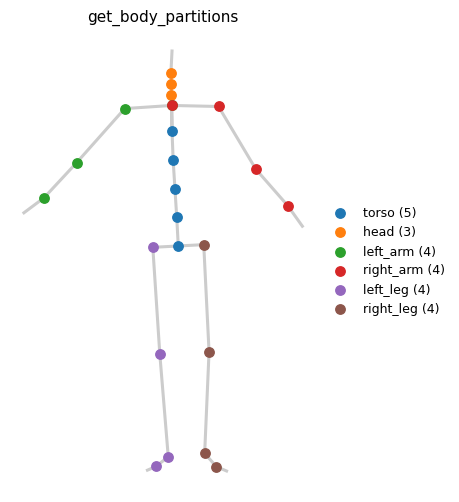
get_body_partitions on a fixture skeleton — each named group colored. (Gallery for the edge/L-R-pair figure too.)
All-in-one: get_skeleton_info
info = pybvh_ml.get_skeleton_info(bvh)
# joint space: {"edges", "lr_pairs", "lr_mapping", "joint_names",
#               "euler_orders", "num_joints"}
# node space:  {"num_nodes", "node_names", "node_edges", "node_lr_pairs",
#               "end_site_indices"}
# plus:        {"fk_topology", "mismatched_end_site_pairs",
#               "world_up", "rest_forward", "rest_up"}

info = pybvh_ml.get_skeleton_info(bvh, include_partitions=True)  # + "body_partitions"
The dict is JSON-serializable and carries everything downstream code needs:
edges,lr_pairs,lr_mapping,body_partitions— joint-space graph topology.num_nodes,node_names,node_edges,node_lr_pairs,end_site_indices— the same in node space, for anode_posstream.joint_names,euler_orders,num_joints— array bookkeeping (e.g.euler_ordersfor euler-representation augmentation or conversion).world_up,rest_forward,rest_up— the axis strings that configure augmentation (up_axis=forrotate_vertical/AugmentationPipeline.standard).rest_upisNonefor degenerate rigs.fk_topology— bone offsets, parent indices, joint-column indices and Euler orders: everything forward kinematics reads, as plain lists.mismatched_end_site_pairs— see below.
preprocess_directory stores exactly this dict in the dataset file, which is why a preprocessed dataset is self-sufficient: AugmentationPipeline.standard(data["skeleton_info"], ...) works without reopening any source BVH.
Running forward kinematics at train time
fk_topology is what makes the FK refresh possible with the source .bvh long closed. Rebuild it once per dataset — pybvh's constructor validates, which is not free — and hand it to the augmentation step:
topology = pybvh_ml.build_fk_topology(data["skeleton_info"])
pipeline = AugmentationPipeline.standard(data["skeleton_info"])  # wires it for you
Datasets written before 0.6.0 carry no fk_topology and it is not recoverable from the other keys — the bone offsets are stored nowhere else — so build_fk_topology raises rather than guessing. Re-run preprocess_directory.
The end-site pairing check
node_lr_pairs drops a pair's end sites when the two sides carry different numbers of them: pybvh has no well-defined tip correspondence there, and its property filters rather than raises, matching lr_pairs. That policy is right for pybvh and wrong for us if left unchecked — we persist the pair list and mirror at train time, far from any Bvh, so a dropped tip silently produces exactly the half-swapped skeleton pybvh.transforms.mirror refuses to emit.
So get_skeleton_info records the offending pairs while the Bvh is still open:
info["mismatched_end_site_pairs"]   # [] on a well-formed rig; node-space pairs otherwise
pybvh_ml.find_mismatched_end_site_pairs(bvh)   # the same check, standalone
A non-empty list means a node-space mirror would swap those paired joints but leave their end sites on the original side. Fix the rig, or drop to joint space.
Where the boundary is
pybvh-ml hands you index lists — it does not build adjacency matrices, graph convolution layers, or attention masks. Those are two lines of your model code, and their conventions (self-loops? normalized? partitioned adjacency à la ST-GCN?) belong to the model, not the data layer:
import numpy as np

A = np.zeros((info["num_joints"] + 1,) * 2)   # +1: root is vertex 0 in packed layouts
for child, parent in info["edges"]:
    A[child + 1, parent + 1] = A[parent + 1, child + 1] = 1
Which key indexes which packing
The + 1 above is not universal — it depends on what you packed:
| packing | V |
edges that index it directly |
|---|---|---|
streams=("joint_pos",) |
J |
edges — one to one, no shift |
streams=("node_pos",) |
N |
node_edges — one to one, no shift |
anything including "root_pos" |
1 + J |
edges, shifted: (child + 1, parent + 1) |
The default ("root_pos", "joint_rot") is the third row, which is where the off-by-one comes from: edges uses joint indices 0..J-1 while the packed layout puts the root at vertex 0. Pack ("joint_pos",) and there is no off-by-one to mind. The same applies to the L/R pair lists.
See also
- Skeleton Metadata API — full signatures
- Tensor Layouts & Packing — the vertex indexing the graph must match