Data Augmentation
All augmentation transforms support seeded randomization for reproducibility. Available as both Bvh methods and standalone functions in pybvh.transforms.
Transforms
Left-right mirroring
from pybvh import transforms

# Auto-detects joint pairs and lateral axis
bvh_mirrored = transforms.mirror(bvh)

# Or explicit
mapping = bvh.lr_mapping                      # name pairs (or None)
pairs = transforms.auto_detect_lr_pairs(bvh)  # index pairs
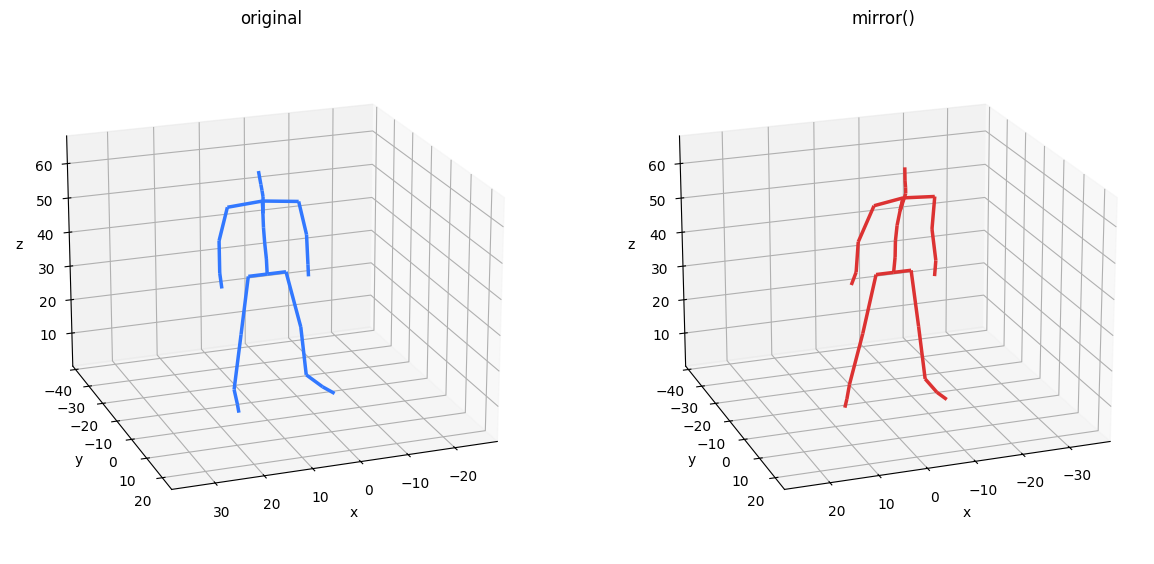
Mirroring is not just an axis flip: the lateral axis is negated and every Left*/Right* pair swaps data, so the result stays anatomically possible. (Gallery, section 3, for every transform drawn.)
L/R pair detection
pybvh auto-detects left/right joint pairs at load time by scanning joint names. The heuristic recognizes:
Left*/Right*(any case), substring anywhere in the name —LeftArm,leftArm,LeftEyeL*/R*prefix followed by an uppercase letter —LArm,RArm*.L/*.R,*_L/*_R, and their lowercase variants —Arm.L,leg_r*.Left/*_Leftand lowercase variants —Arm.Left,leg_right- Mixamo namespace prefix stripped automatically —
mixamorig:LeftArm - Blender numbered duplicates stripped automatically —
Arm.L.001
The detected mapping lives on bvh.lr_mapping (a dict[str, str] or None). You can inspect, override, or provide it explicitly:
# Inspect
print(bvh.lr_mapping)  # {"LeftArm": "RightArm", ...} or None

# Override post-load (B1 setter)
bvh.lr_mapping = {"arm.L": "arm.R", "leg.L": "leg.R"}

# Or provide at load time (B3 kwarg)
bvh = pybvh.read_bvh_file("weird.bvh", lr_mapping={"arm.L": "arm.R", ...})
bvh_list = pybvh.read_bvh_directory("dataset/", lr_mapping={...})  # applied to every file
If the heuristic can't parse the skeleton's naming, bvh.lr_mapping is None and mirror() raises a ValueError pointing at the remediation above. User-set mappings are lost on bvh.write() — re-apply after reading.
Vertical rotation
Angles are in radians (like Bvh.joint_angles); pass degrees=True to work in degrees.
bvh_rotated = transforms.rotate_vertical(bvh, np.pi / 2)
bvh_rotated = transforms.rotate_vertical(bvh, 90, degrees=True)   # same thing
bvh_random = transforms.random_rotate_vertical(bvh, rng=np.random.default_rng(42))  # uniform over (-pi, pi)
The rotation turns about the world origin by default, so a character captured away from the origin sweeps along an arc rather than turning where it stands. pivot= chooses the point instead:
bvh_turned = transforms.rotate_vertical(bvh, np.pi / 2, pivot="root")        # turn in place
bvh_turned = transforms.rotate_vertical(bvh, np.pi / 2, pivot=[100, 0, -50])  # about a fixed landmark
pivot="root" is the first frame's root position projected to the ground plane. Only the two horizontal components of an explicit point are read — every point on a vertical line spans the same rotation axis — so heights are never altered by the choice, and neither are joint angles: the pivot moves the root trajectory and nothing else. Equivalently, pivot="root" is center on the first-frame root → rotate about the origin → un-center, which means a pipeline that already centers its clips gets turn-in-place from the default and needs no pivot=.
Speed perturbation
bvh_fast = transforms.perturb_speed(bvh, factor=1.5)  # 1.5x faster
bvh_slow = transforms.perturb_speed(bvh, factor=0.7)  # slower
Noise injection
Rotation noise and translation noise are separate calls, because their sigmas are in different units — radians for joint angles, the skeleton's length unit for the root. By default noised angles are left unwrapped (BVH channels can legitimately hold values outside [-π, π]); pass wrap=True to wrap them into [-π, π].
bvh_noisy = transforms.add_rotation_noise(bvh, sigma=0.02, rng=rng)      # radians
bvh_noisy = transforms.add_position_noise(bvh_noisy, sigma=0.5, rng=rng)  # length
Only add_rotation_noise takes degrees=True; there is no angular unit for a translation.
Root translation
Frame dropout
Dropped frames are re-synthesized by SLERP between the nearest kept neighbours; kept frames are preserved exactly.
Composing transforms
All Bvh-level transforms return new Bvh objects (when inplace=False, the default), so they can be chained:
rng = np.random.default_rng(42)

augmented = (bvh
    .mirror()
    .rotate_vertical(np.pi / 2)
    .add_rotation_noise(sigma=0.02, rng=rng)
    .perturb_speed(1.2))
For reproducible augmentation pipelines, pass a seeded rng to each stochastic transform. Deterministic transforms (mirror, rotate_vertical, scale) don't need one.
Array-level functions
For ML pipelines that work with pre-extracted arrays (not Bvh objects):
from pybvh.transforms import rotate_angles_vertical, mirror_angles

# Operate directly on (F, J, 3) Euler arrays
new_angles, new_pos = rotate_angles_vertical(
    bvh.joint_angles, bvh.root_pos, angle=np.pi / 4,
    up_idx=1, root_order="ZYX")   # same pivot= as the Bvh-level twin

# Mirror with index pairs
pairs = transforms.auto_detect_lr_pairs(bvh)
rot_ch = [list(n.rot_channels) for n in bvh.nodes if not n.is_end_site()]
m_angles, m_pos = mirror_angles(
    bvh.joint_angles, bvh.root_pos, pairs, lateral_idx=0, rot_channels=rot_ch)
For tensor-level augmentation pipelines
pybvh provides per-Bvh transforms in Euler space. For batched augmentation on packed tensors in quaternion or 6D space (e.g., during training), see the companion library pybvh-ml.
See also
Gallery — every transform drawn as before/after (section 3) · Transforms API — full signatures · World Up & Orientation — the up-axis and L/R conventions mirror and rotate_vertical rely on