Core Concepts
The BVH format
A BVH file has two sections:
- HIERARCHY — defines a skeleton as a tree of joints. Each joint has an offset (bone vector from parent) and rotation channels (e.g.,
Zrotation Yrotation Xrotation). Leaf nodes called "End Sites" have only an offset. - MOTION — per-frame data. Each frame is a row of floats: root position (3 values) followed by Euler angles for every joint.
The Bvh object
Bvh is the central container. It holds:
| Attribute | Shape | Description |
|---|---|---|
root_pos |
(F, 3) |
Root translation per frame |
joint_angles |
(F, J, 3) |
Euler angles (radians) per joint per frame |
nodes |
list | All skeleton nodes (joints + end sites) in depth-first order |
joint_names |
list of str | Non-end-site joint names |
euler_orders |
list of str | Per-joint Euler orders (e.g. ['ZYX', ...]) |
edges |
list of tuples | Skeleton edge list as (child_idx, parent_idx) |
frame_time |
float | Seconds per frame |
world_up |
str | Gravity axis (e.g. '+y', '+z'). Auto-detected, settable. |
Index spaces
pybvh has two index spaces:
node_index— includes end sites. Maps tobvh.nodeslist. Used bynode_positions().joint_anglesindex — excludes end sites. Maps tobvh.joint_namesandbvh.joint_anglesaxis 1. Used byedges,euler_orders, augmentation functions.
Most functions use the joint_angles index space. The docstring of each function specifies which space it expects.
Centered modes
Several functions accept a centered parameter:
"world"— positions as stored in the BVH file"skeleton"— root forced to(0, 0, 0)every frame"first"— ground-plane centering: the first frame's root position is subtracted in the two horizontal axes only (theworld_upcoordinate is untouched), so the motion starts above the origin at its original height
One look makes the difference obvious — same walking clip, same frame, three coordinate frames (the blue trail is the root's path over the whole clip):
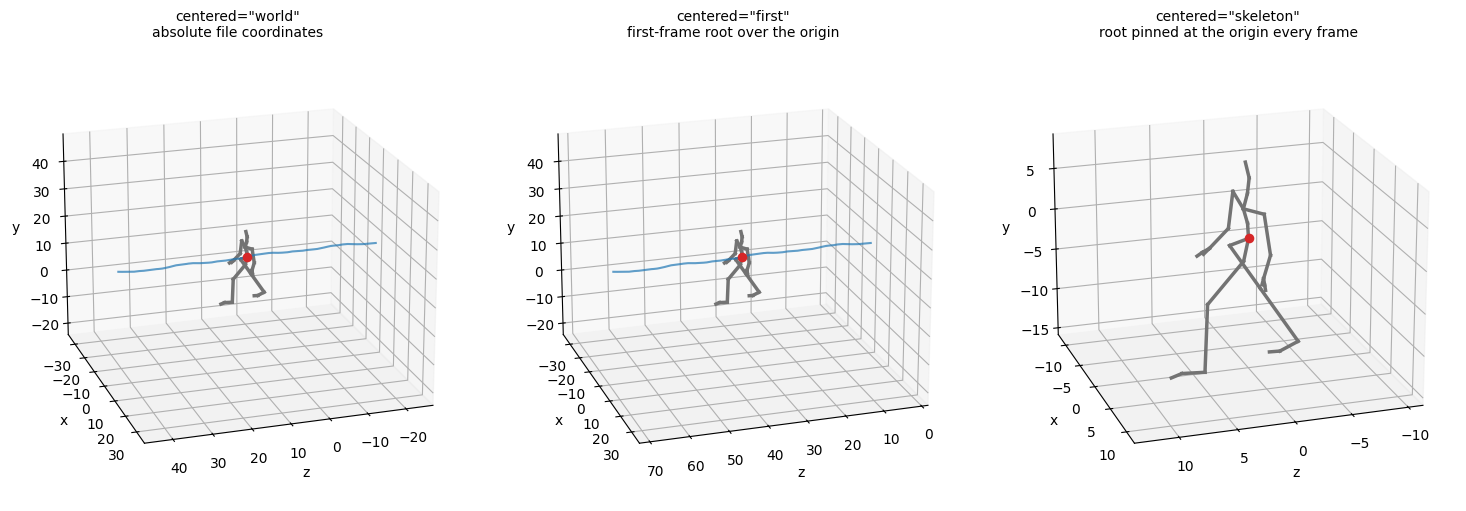
More one-figure-per-feature visuals: the Gallery.
See also
World Up & Orientation — the up-axis and facing conventions behind centered · Bvh Class API — every attribute and method · Quick Start