Choosing a Rotation Representation
pybvh supports five rotation representations. Each has trade-offs that make it better suited for different tasks. This page is the decision guide — the conversion API, shapes, and SE(3) layer live in Rotation Representations & SE(3).
Decision table
| Representation | Shape | Continuous? | Best for |
|---|---|---|---|
| Euler angles | (*, 3) |
No (gimbal lock, discontinuities) | BVH native format, human-readable inspection, storage |
| Rotation matrices | (*, 3, 3) |
Yes | Forward kinematics, composing rotations, intermediate conversions |
| 6D (Zhou et al.) | (*, 6) |
Yes | Neural network output layers (no discontinuity penalty during training) |
| Quaternions | (*, 4) |
No (antipodal equivalence) | Smooth interpolation (SLERP), compact storage, physics engines |
| Axis-angle | (*, 3) |
No (wraps at 2pi) | Small rotations, angular velocity, rotation visualization |
When to use each
Euler angles
The native BVH format. Use when reading/writing files or when you need human-readable rotation values. Avoid for ML training (discontinuities at gimbal lock cause gradient problems) and for interpolation (linear interpolation in Euler space is not physically meaningful).
6D rotation (Zhou et al.)
The recommended representation for neural networks. It is continuous — nearby rotations map to nearby 6D vectors — so gradient-based optimization works smoothly. Use bvh.to_6d() for feature extraction and bvh.from_6d() to convert predictions back.
The continuity difference in one picture — a smooth rotation crossing the ±180° boundary, read out in three representations:
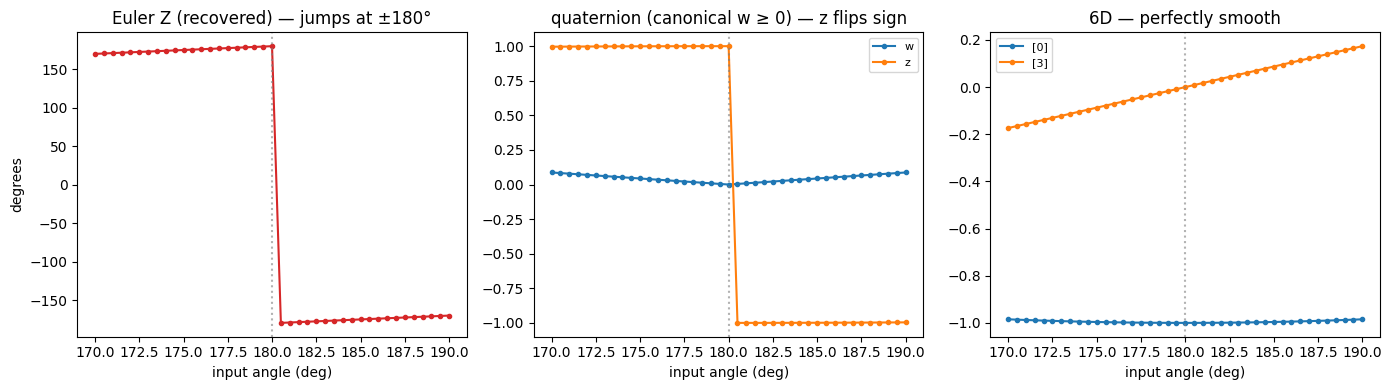
Euler jumps, the canonical quaternion flips sign where w crosses zero, 6D stays smooth. (Gallery, section 2.)
Quaternions
Best for interpolation via rotations.quat_slerp(). Compact (4 values vs. 9 for matrices). However, quaternions have double cover (q and -q represent the same rotation), which can cause discontinuities during training. pybvh canonicalizes to w >= 0.
Rotation matrices
Useful as an intermediate representation for composing rotations or for forward kinematics. Rarely used directly as ML features due to redundancy (9 values with 6 constraints).
Axis-angle
Compact (3 values) and intuitive (direction = axis, magnitude = angle). Good for representing small perturbations or angular velocities. Discontinuous at 2*pi wrapping.
Converting between representations
Any pair converts directly — see Rotation Representations & SE(3) for the conversion API and shape conventions, and the Gallery for the continuity figure that shows why 6D wins for training.